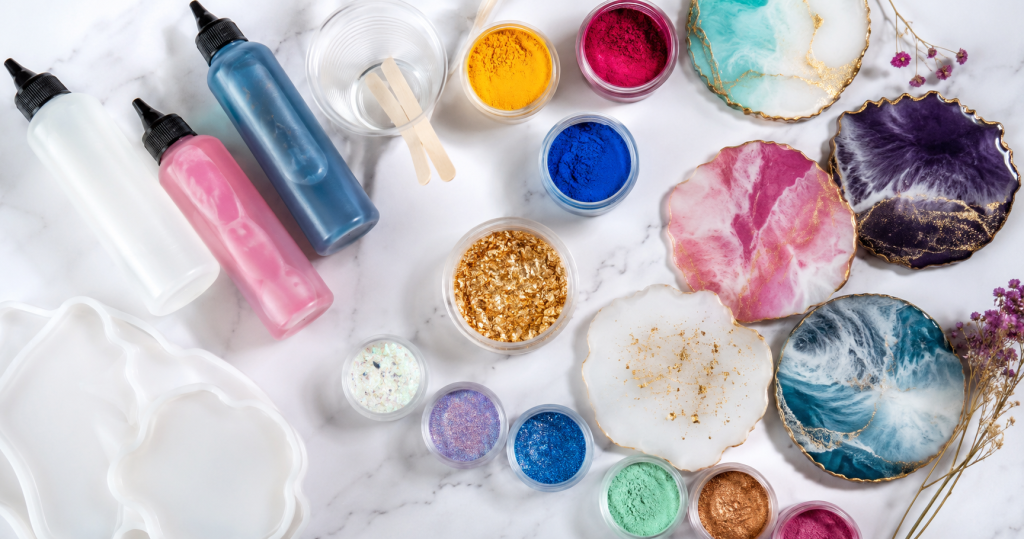
Creating beautiful resin art involves more than just the pour itself. The finishing stages — demolding, sanding, polishing and applying topcoats — are what transform a good resin piece into a professional-quality finished product. Equally important is knowing how to identify and fix the problems that inevitably arise when working with resin. This article covers everything you need to know about finishing your resin pieces to a professional standard and troubleshooting the most common resin art problems.
Understanding the Curing Process
Before discussing demolding and finishing it is important to understand the resin curing process and its stages. Epoxy resin cures in stages and the timing of demolding and finishing operations depends on understanding where in the curing process your piece is at any given time.
The initial cure or gel stage occurs within the first few hours after pouring. At this stage the resin has transitioned from a liquid to a gel-like solid. It holds its shape but is still somewhat soft and flexible and will take an impression from anything pressed against it. Do not attempt to demold pieces at this stage.
The handling cure stage typically occurs between 16 and 24 hours after pouring depending on the resin product. At this stage the resin is hard enough to handle carefully but has not yet reached its full hardness and scratch resistance. You can demold pieces at this stage if necessary but handle them carefully and avoid any surface contact that might scratch the still-developing surface.
The full cure stage typically occurs between 3 and 7 days after pouring. At full cure the resin has reached its maximum hardness, scratch resistance and chemical resistance. This is the ideal stage for finishing operations like sanding and polishing that require the resin to be at its hardest.
Demolding Your Resin Pieces
Demolding — removing your finished pieces from their molds — is a straightforward process when done at the right time and with the right technique.
For silicone molds wait until at least the handling cure stage before attempting to demold. Gently flex the mold on all sides to begin releasing the suction between the mold and the resin. Then push gently from the back of the mold while pulling the sides away from the piece. Most silicone molds release their contents quite easily — if you are experiencing significant resistance the piece may not have cured sufficiently and you should wait longer.
For wooden molds or pieces poured directly onto surfaces the piece will need to be carefully pried away using a palette knife or similar flat tool inserted carefully under the edge of the piece. Work gradually around the entire perimeter rather than trying to force the piece away from one point.
Sanding Resin
Sanding is used to remove surface imperfections from cured resin pieces including drips, runs, uneven edges and scratches. It is also the first step in achieving a high-gloss polished finish on pieces that have a dull surface after curing.
Always sand fully cured resin — ideally at the full cure stage of 3 to 7 days. Sanding insufficiently cured resin produces a gummy, unpleasant result and can damage the surface.
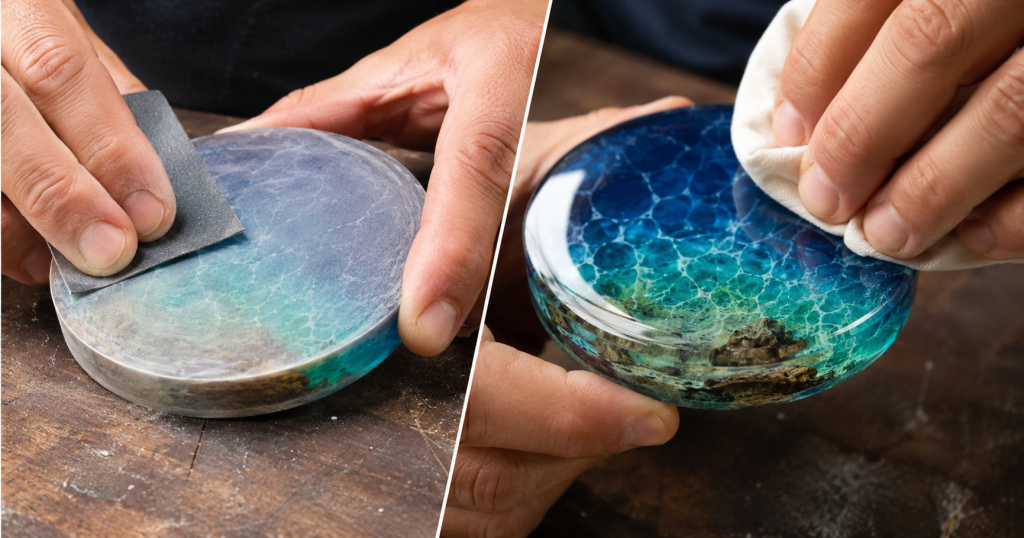
Begin with a relatively coarse sandpaper — 220 to 400 grit — to remove significant imperfections and shape edges. Work up progressively through finer grits — 400, 800, 1200, 2000 and finally 3000 grit — using each grit to remove the scratches left by the previous grit. Wet sanding using water as a lubricant produces better results and less dust than dry sanding for the finer grits.
After sanding through to your finest grit the surface will appear uniformly hazy and dull. This is normal and indicates that the surface is well prepared for polishing.
Polishing Resin
Polishing removes the fine scratches left by sanding and restores the high-gloss surface characteristic of quality resin art. Use a plastic polishing compound or car polishing compound applied with a soft cloth or polishing machine.
Apply the polishing compound to the sanded surface and work it in using circular motions with moderate pressure. The compound will initially appear white and milky but will gradually become clearer as the fine scratches are removed and the surface achieves its final gloss.
Finish with a clean, soft microfiber cloth to remove any residue and buff the surface to its final high gloss. The transformation from dull sanded surface to brilliant gloss is one of the most satisfying moments in resin art.
Troubleshooting Common Resin Problems
Even experienced resin artists encounter problems from time to time. Knowing how to identify and address common resin problems saves materials and frustration.
Sticky or soft resin after the expected cure time has elapsed is the most common and frustrating resin problem. It is almost always caused by incorrect measurement ratio or incomplete mixing. Unfortunately fully sticky resin that has not cured at all typically cannot be salvaged — it must be scraped away and the project started again. Partially sticky areas on an otherwise well-cured piece can sometimes be saved by carefully removing the sticky material and applying a topcoat of properly mixed resin over the affected area.
Bubbles in the cured piece result from insufficient bubble removal during and after pouring. Prevention is the best approach — thorough use of a heat gun during the working window removes the vast majority of bubbles before they are trapped in the curing resin. For pieces that have already cured with visible bubbles the only solution is sanding down to below the level of the bubbles and applying a fresh topcoat.
Cloudiness or haziness in cured resin can result from several causes including moisture contamination, working in cold temperatures that slow the curing reaction or adding too much colorant. Work in a warm dry environment and add colorants in moderate quantities to minimize cloudiness.
Yellowing of clear resin over time is caused by UV light exposure. UV-resistant art resins resist yellowing significantly better than non-UV-resistant products. Keep finished pieces away from direct sunlight and apply UV-resistant topcoats to maximize long-term clarity.
Uneven surfaces result from pouring on a non-level surface. Always check that your work surface is perfectly level using a spirit level before pouring and do not disturb your piece during curing.