
You have learned about resin, gathered your materials, understood the safety requirements and mastered the basics of mixing and color work. Now it is time for the most exciting part — making your first resin art pieces. This article provides detailed step-by-step instructions for three beginner-friendly projects that will build your skills progressively while producing beautiful, usable finished pieces. By the end of these three projects you will have a solid practical foundation in resin art and genuine confidence in your abilities.
Project 1: Resin Coasters
Resin coasters are the perfect first project for several reasons. They are small enough to be manageable without requiring large quantities of expensive resin. They are practical and immediately usable. They make excellent gifts. And they provide an excellent canvas for practicing color work and different design techniques.
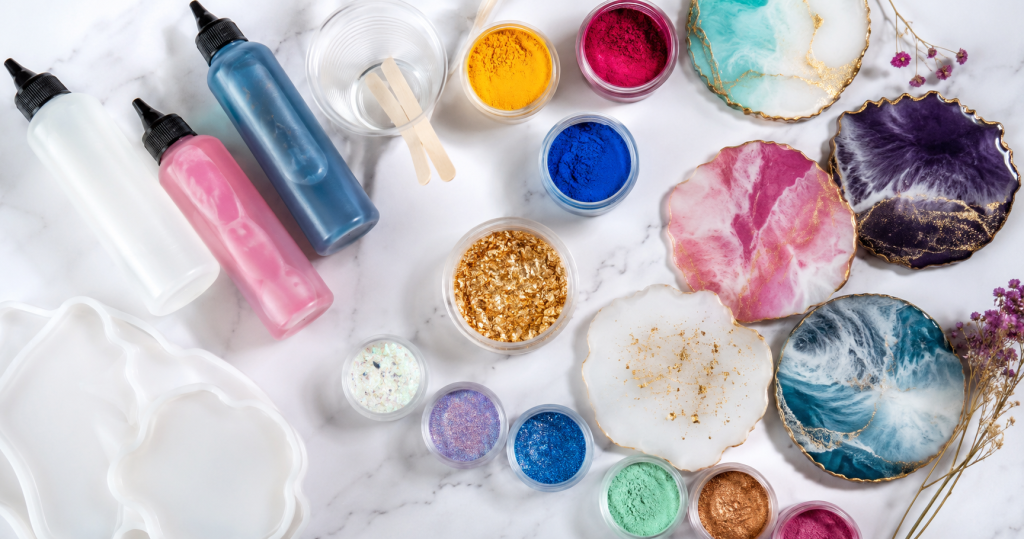
For this project you will need silicone coaster molds in your chosen shapes, mixed and colored resin, a heat gun for bubble removal and patience while your coasters cure.
Begin by preparing your workspace and gathering all your materials before mixing any resin. Ensure your molds are clean, dry and placed on a perfectly level surface. Mix your resin according to the instructions in Article 4 of this series. Divide your mixed resin into separate cups and add your chosen colors to each portion.
For your first coasters keep the design simple. A two or three color pour is more manageable for beginners than complex multi-color designs. Pour your first color into the mold filling it to approximately half depth. Add your second color in a gentle stream across the first. Add any additional colors in streams or drops. Use a stir stick to gently swirl the colors together if desired — a few gentle movements are sufficient.
Pass your heat gun quickly over the surface of the poured resin to remove bubbles. Hold the heat gun approximately 15 to 20 centimeters above the surface and keep it moving to avoid concentrating heat in one spot. You will see the bubbles pop as the heat passes over them.
Allow your coasters to cure for the time specified by your resin manufacturer. Do not touch or disturb them during this time. Once fully cured demold your coasters by gently flexing the silicone mold. Your finished coasters should pop out cleanly revealing their beautiful designs.
Sand any rough edges with fine sandpaper and apply a thin topcoat of clear resin for a perfectly glossy finish if desired. Your first set of resin coasters is complete.
Project 2: Resin Decorative Tray
A resin decorative tray is a step up in complexity from coasters but is still very manageable for a beginner who has completed a few coaster projects. Trays are highly decorative and functional objects that are always in demand as gifts and home accessories.
You will need a silicone tray mold or a wooden tray that you will coat with resin, mixed resin in your chosen colors and a heat gun. If using a wooden tray ensure it is clean, dry and sealed with a coat of resin or varnish before applying your decorative pour.
For your tray design consider creating a more complex pattern than your coasters. A flowing abstract design using three or more colors, a marble effect using white and grey with gold metallic accents or a bold color-block design using two contrasting colors are all excellent choices for a decorative tray.
Mix a larger quantity of resin than for coasters allowing for the larger surface area of the tray. Add your colors and pour them into the tray in your chosen pattern. Use a heat gun, a skewer or a stir stick to manipulate the colors into your desired design. Work relatively quickly as larger quantities of resin have a shorter effective working time than small amounts.
Remove bubbles with your heat gun and allow to cure completely. Once cured demold or if working on a wooden tray allow the resin surface to harden completely before handling.
Project 3: Resin Wall Art on Canvas
Creating resin wall art on canvas is a step up from the previous projects in terms of both scale and complexity but the skills you have developed in the previous projects prepare you well for this challenge. A beautiful resin canvas is a genuinely impressive finished piece that can be displayed proudly or sold for a good price.
You will need a canvas panel in your chosen size, mixed resin in multiple colors, a heat gun and a level elevated surface to pour onto. Elevating your canvas on cups or small blocks allows the excess resin to drip off the edges cleanly.
For your first canvas resin piece the ocean effect described in Article 5 is an excellent choice as it is forgiving of slight variations in technique and produces reliably beautiful results. Alternatively an abstract pour design using multiple complementary colors creates a striking, unique artwork.
Begin by applying a base coat of white or colored resin to seal the canvas surface and provide a foundation for your pour. Allow this to cure to a gel consistency — still slightly tacky but not fully cured. This gel stage is the optimal time to apply your pour design as the colors will blend into the base coat creating more depth and integration than pouring onto a fully cured surface.
Apply your colors in your chosen pattern and manipulate them with a heat gun to create your desired design. The canvas will need to remain perfectly level during curing — use a spirit level to check before walking away.
Allow your canvas to cure completely — at least 24 hours and ideally 48 hours — before moving it. Once fully cured your resin canvas artwork is ready to display or sell.