
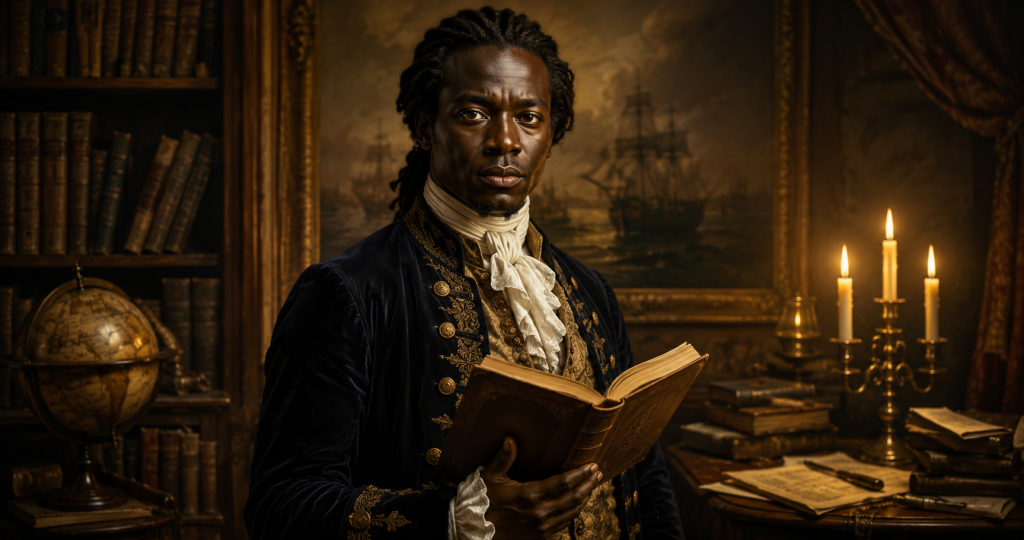
Few stories in human history are as remarkable, moving and historically significant as the story of Olaudah Equiano. Born in what is now southeastern Nigeria around 1745, Equiano was kidnapped from his home as a child, endured the horrors of slavery and the transatlantic slave trade, eventually purchased his own freedom and went on to become one of the most powerful voices in the movement to abolish the slave trade. His story is a testament to the extraordinary resilience of the human spirit and the power of one person’s voice to change the world.
A Childhood Cut Short
Olaudah Equiano was born into the Igbo people of what is today Ebonyi or Anambra State in southeastern Nigeria. In his autobiography he describes a happy childhood in a prosperous family. His father was an elder of their community, a man of status and respect. Young Equiano grew up learning the customs, values and traditions of his people in a community that, while unfamiliar to European eyes, was organized, cultured and deeply human.
That happy childhood ended abruptly when Equiano was approximately eleven years old. While his parents were away working in the fields, he and his sister were kidnapped by slave raiders. It was the beginning of a nightmare that would take him thousands of miles from his home and plunge him into the darkest institution in human history.
The Horrors of the Middle Passage
After being sold multiple times within Africa, Equiano eventually reached the West African coast where he encountered something that filled him with absolute terror — a slave ship. In his autobiography he describes seeing the ocean for the first time and being convinced that he had fallen into the hands of evil spirits who intended to eat him.
The reality was in many ways worse than his fears. Equiano was loaded onto a slave ship and subjected to the horrific experience known as the Middle Passage — the transatlantic voyage that carried millions of enslaved Africans from their homeland to the Americas. The conditions aboard slave ships were unimaginably brutal. Enslaved people were packed so tightly below decks that they could barely move. Disease was rampant. Many died before reaching their destination.
Equiano survived the Middle Passage and arrived in the Caribbean before eventually being taken to Virginia in North America. His account of the Middle Passage, published decades later in his autobiography, would become one of the most powerful pieces of evidence used by abolitionists to argue for the end of the slave trade.
Life in Slavery
Equiano experienced slavery in several different forms. He worked on plantations, served as a naval officer’s assistant during the Seven Years War and worked as a merchant sailor. His intelligence, literacy and the relative latitude afforded him by some of his owners allowed him to educate himself and to develop the skills that would eventually enable him to purchase his freedom.
Not all of Equiano’s experiences of slavery were equally brutal but he never lost sight of the fundamental injustice of his situation. He witnessed terrible cruelties inflicted on enslaved people and was himself subjected to arbitrary violence and injustice. These experiences shaped his deep moral conviction that slavery was an abomination that had to be ended.
The Road to Freedom
Equiano’s path to freedom was unusual. Through his work as a merchant sailor he was able to engage in small-scale trading on his own account, carefully saving the profits. After years of patient effort he had accumulated enough money to purchase his own freedom from his owner Robert King in 1766. He was approximately 21 years old.
The moment of his manumission, the legal document granting him freedom, was one of the most significant of his life. In his autobiography he describes the overwhelming joy and relief he felt at finally being a free man. Yet he was also acutely aware that his freedom was fragile and that as a Black man in a world dominated by slavery and racial prejudice, he remained vulnerable in ways that white men were not.
Becoming a Voice for Abolition
After gaining his freedom Equiano settled in Britain where he became involved in the growing movement to abolish the slave trade. He became friends with leading abolitionists including Granville Sharp and was a member of the Sons of Africa, a group of prominent Africans in Britain who advocated for abolition and the rights of Black people.
In 1789 Equiano published his autobiography, The Interesting Narrative of the Life of Olaudah Equiano, or Gustavus Vassa, the African. The book was an immediate sensation. It went through nine editions in his lifetime and was translated into multiple languages. It was read by members of Parliament, by ordinary citizens and by influential figures across Britain and America.
The book’s power lay in its humanity. Equiano was not an abstract statistic or a distant victim. He was a real person with a name, a family, a childhood, hopes, fears and a voice. His account of the slave trade from the perspective of someone who had lived it was devastating in its impact and impossible to dismiss.
Legacy and Impact
Olaudah Equiano died in 1797, just ten years before the British Parliament passed the Slave Trade Act of 1807 which abolished the slave trade in the British Empire. He did not live to see the victory of the cause to which he had devoted so much of his life but his contribution to that victory was immense.
His autobiography remains in print to this day and is studied in universities around the world as a foundational text in the history of slavery, abolition and African literature. He is recognized as one of the founding fathers of African literature in the English language and as one of the most important human rights advocates in history.
Equiano’s story reminds us that one person with courage, determination and a willingness to speak truth to power can change the world. Born into the most degrading circumstances imaginable, he refused to be defined by what was done to him. Instead he used his experience, his intelligence and his voice to fight for justice not just for himself but for millions of others.
His is a story that every African should know and be proud of. It is a story of suffering, yes, but ultimately it is a story of triumph, dignity and the unconquerable human spirit.
Sources and References:
- Equiano, Olaudah. The Interesting Narrative of the Life of Olaudah Equiano (1789)
- Carretta, Vincent. Equiano the African: Biography of a Self-Made Man (2005)
- BBC History: Olaudah Equiano — bbc.co.uk/history
- Encyclopedia Britannica: Olaudah Equiano — britannica.com