Europe is in the grip of one of the most devastating and record-breaking heatwaves in its recorded history. From the sun-scorched streets of Paris to the beaches of Spain and the usually temperate cities of the United Kingdom, temperatures are soaring to levels that are rewriting the history books, claiming lives and forcing governments to take emergency action. And as viral videos capturing the shocking visual impact of this extreme heat spread across social media, the world is watching and asking a question that scientists have already answered — is extreme heat becoming the new normal?
The Numbers That Tell a Story
The statistics emerging from Europe’s June 2026 heatwave are staggering in their scale and significance. Temperature records across the continent have tumbled, with France experiencing its hottest day ever, Spain reaching its highest daily average since 1950 and the United Kingdom experiencing record heat for June.
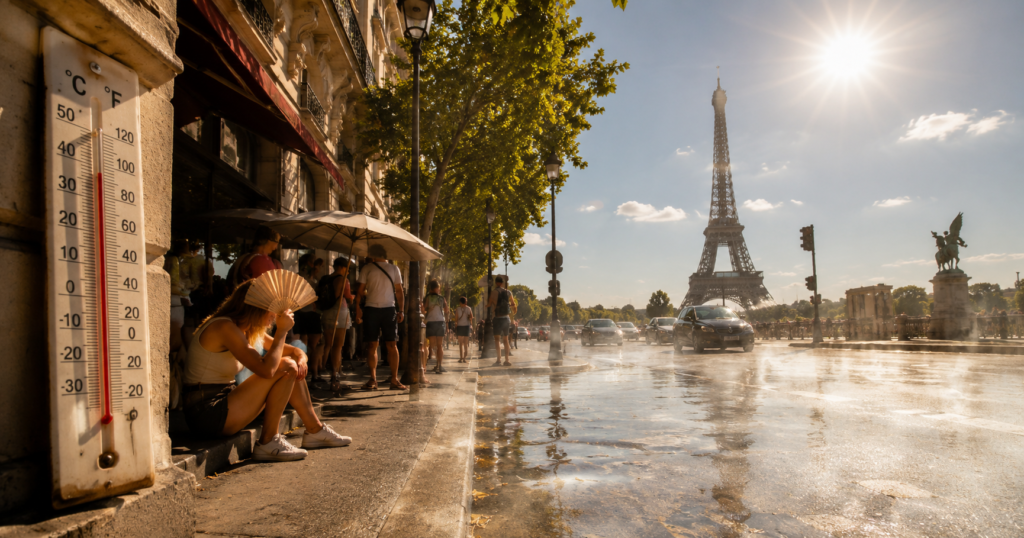
Paris itself hit a June record of 40.9 degrees Celsius — 105.6 degrees Fahrenheit — this week, according to the national weather service Météo-France, which said the country had hit the hottest day since measurements began. In the United Kingdom the situation was equally extraordinary. The UK broke its record for hottest June temperature for the third time in a single day, with the mercury hitting 36.1 degrees Celsius — 96.98 degrees Fahrenheit — in a Hampshire seaside town on the south coast. The country’s previous June record of 35.6 degrees Celsius was set in 1976 during a historic heatwave and had remained unbroken for 50 years.
An exceptionally early and intense heatwave swept across Europe in the days around the 2026 summer solstice, sending temperatures 14 to 18 degrees Celsius above normal for late June and breaking long-standing records. A Saharan heat dome pushed parts of Europe past 44 degrees Celsius.
The Human Cost
Behind the dramatic temperature statistics lies a devastating human story. At least 18 people have died in France including two children and three elderly people amid the heatwave. A two-year-old and a four-year-old were found unconscious by their mother in the family car in the southeast French town of Carpentras. First responders were unable to resuscitate the children. Temperatures in Carpentras exceeded 102.2 degrees Fahrenheit on Monday afternoon.
At least 42 people have drowned in France this week as thousands headed to water to escape temperatures soaring past 104 degrees Fahrenheit. French Prime Minister Sébastien Lecornu confirmed the victims were mostly young people, calling their deaths a tragic scourge.
The French capital has enforced early closures of iconic landmarks such as the Eiffel Tower and the Louvre Museum. Schools have been closed, trains have slowed and power has been knocked out for thousands. French Prime Minister Sébastien Lecornu said he had decided to activate the highest level of public health mobilization called ORSAN level 3 to bolster hospital staffing levels.
The Viral Videos Capturing a Continent in Crisis
As Europe bakes under unprecedented heat, social media has been flooded with viral videos capturing the shocking visual reality of life under extreme temperatures. A widely shared compilation showing dramatic scenes of heat’s impact on everyday objects and surfaces has attracted millions of views and sparked intense debate online.
The footage includes scenes of plastic objects softening under extreme heat, water poured onto hot road surfaces bubbling and evaporating almost instantly and people demonstrating in creative and sometimes dramatic ways just how intense the conditions have become. While the authenticity of individual clips in viral compilations is always subject to scrutiny, the broader conditions that make such scenarios entirely plausible are thoroughly documented by weather agencies and news organizations across Europe.
The videos have generated enormous online reaction with viewers expressing shock, concern and in some cases skepticism about specific clips. What is not in dispute is that the conditions being documented — extreme heat affecting infrastructure, transportation, public health and daily life — are real, verified and historic in their scale.
How Europe Got Here — The Science of the Heat Dome
Understanding how Europe came to be in this situation requires a brief engagement with the meteorological and climatological forces at work. The driver was a powerful upper-level ridge building northward out of northwest Africa, creating a classic heat dome. Sinking air under high pressure compresses and warms, skies stay cloudless and the ground bakes day after day.
From late May 2026 onwards Europe was struck by severe heatwaves with records being broken in Belgium, Spain, Italy, the United Kingdom, Germany, France and Ireland as well as North Africa. The first started on 24 May with temperatures 10 to 15 degrees Celsius higher than normal, causing several deaths. A second more severe heatwave started on 17 June 2026.
Spain’s weather agency AEMET warned that much of the country would endure a heatwave through midweek as a mass of hot dry air from the Sahara pushed temperatures well above seasonal norms. The Saharan origin of this superheated air mass is significant — it illustrates how climate patterns from North Africa are increasingly influencing weather conditions far to the north, a trend that climate scientists have been monitoring with growing concern.
Is This the New Normal?
The question that the viral videos pose — are extreme heat events becoming the new normal — is one that climate science has already answered with sobering clarity. Europe is the fastest-warming continent, heating at roughly twice the global average. As the baseline climate warms, the same weather patterns that have always brought summer heat now deliver more extreme spikes and they arrive earlier in the season. Meteorologists pointed to climate change as a clear contributing factor in the unusually early onset of this heatwave. Events that were once rare are becoming a near-annual feature of European summers with serious implications for health, agriculture, energy demand and the wildfire season.
Of the 52 heatwaves recorded in France since 1947 two-thirds have happened since the beginning of the 21st century according to Météo-France. Meanwhile in the UK the number of days hotter than 30 degrees Celsius more than tripled in 2015 to 2024 compared to 1961 to 1990 according to a 2024 Met Office report.
This June heatwave comes a month after the UK experienced the hottest May on record. If the hottest June temperatures are observed this week as is likely it will be the first time since 1911 that two consecutive months have seen record temperatures.
What Happens to Infrastructure Under Extreme Heat
One of the most important and underreported aspects of Europe’s heatwave is the impact on infrastructure. Heat-related deaths, wildfire alerts across France and Iberia and heat-stressed power grids including blackouts in Turin followed the temperature spike.
The deadly record-setting heatwave has killed dozens of people, closed schools, slowed trains, knocked out electricity and forced farmers to harvest grain at night. The disruption to normal life caused by extreme heat extends far beyond personal discomfort — it affects transportation networks, energy systems, food production and the fundamental ability of cities to function normally.
Governments across Europe have taken precautionary measures including cancelling some public events while some schools have closed or modified their timetables. These responses reflect a growing recognition that extreme heat is not simply an inconvenience but a genuine public health and infrastructure emergency that requires coordinated government action.
Staying Safe in Extreme Heat — Official Advice
As the heatwave continues health officials across Europe and around the world are urging people to take the threat of extreme heat seriously and to take practical steps to protect themselves and others.
Staying hydrated by drinking water regularly is the most important single measure anyone can take during extreme heat. Dehydration can develop rapidly in high temperatures before thirst becomes apparent and it significantly increases the risk of heat exhaustion and heat stroke. Avoiding outdoor activity during the hottest parts of the day — typically between 11am and 4pm — dramatically reduces heat exposure and the associated health risks.Those without air conditioning at home are strongly advised to spend time in air-conditioned public spaces during peak heat hours. Wearing loose, light-colored clothing helps the body manage temperature more effectively. Perhaps most importantly checking on elderly neighbors, relatives and others who may be vulnerable and isolated can be genuinely lifesaving — heat-related illness among the elderly often goes unnoticed until it becomes critical.
A Warning the World Must Hear
Europe’s 2026 heatwave is not simply a European story. It is a global warning about what happens when the climate system is pushed beyond its historical boundaries. The viral videos capturing the dramatic visual impact of extreme heat are attention-grabbing and shareable — but the real story is deeper, more serious and more urgent than any single clip can convey.
For scale France alone averages around 5,400 heat deaths a year and the deadly summer of 2003 killed an estimated 70,000 people across Europe. The 2026 heatwave is being described by meteorologists and climate scientists as consistent with and likely intensified by human-driven climate change — and without significant action to reduce greenhouse gas emissions events of this kind will become more frequent, more intense and more deadly.
The question is no longer whether extreme heat is becoming the new normal. It already has. The question now is what the world chooses to do about it.
Sources and References:
- NBC News: Europe Heatwave Coverage — nbcnews.com
- CNN: Europe Heatwave Live Updates — cnn.com
- Time Magazine: Europe Heatwave Safety Guide — time.com
- Wikipedia: 2026 European Heatwaves — wikipedia.org
- Mappr: Europe Heatwave Peak Temperatures Map — mappr.co