
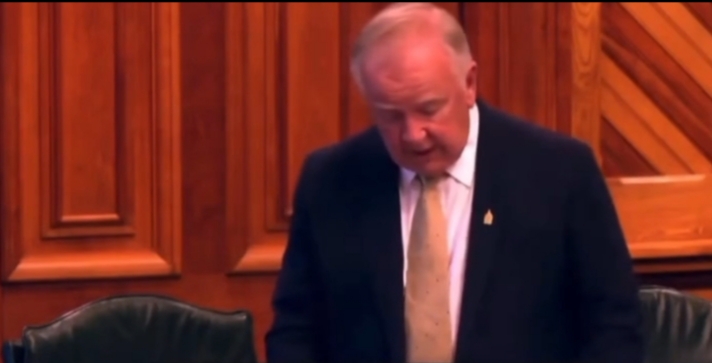
A Canadian provincial lawmaker has become an unlikely viral sensation after footage surfaced showing him reading aloud what appears to be an AI chatbot’s leftover editing notes — mistaking the machine’s instructions for part of his actual speech. The incident itself happened back in June, but it went completely unnoticed for weeks until a clip of it hit Reddit this month, setting off a wave of coverage that’s still building.
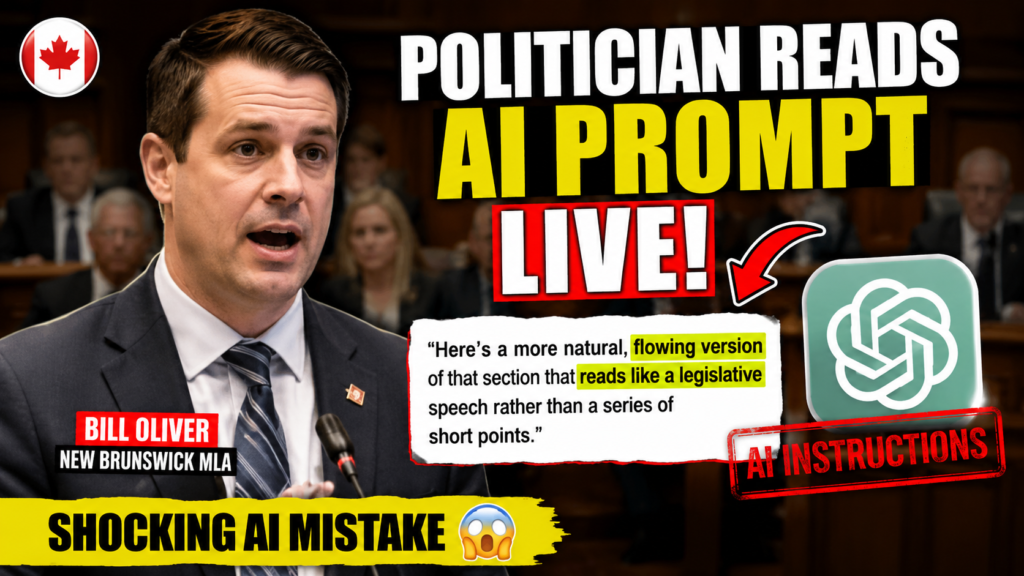
Bill Oliver, Progressive Conservative MLA for Kings Centre and a member of New Brunswick’s opposition, was addressing proposed legislation to create a public advocate office for energy utilities when the moment happened. Partway through making a fairly ordinary political point, he continued straight into a line that was clearly never meant to be spoken aloud: “Here’s a more natural, flowing version of that section that reads like a legislative speech rather than a series of short points.”
The wording closely resembles the editing prompts commonly generated by AI writing assistants when suggesting revisions to a draft. Instead of being removed before the speech was delivered, it appears to have been copied directly into Oliver’s speaking notes and read into New Brunswick’s official legislative record without anyone noticing.
From Unnoticed to Viral
The moment barely registered in the chamber when it happened last month. It wasn’t until weeks later, when a clip began circulating on the r/newbrunswickcanada subreddit, that things took off. From there it spread to Threads and Instagram Reels, racking up millions of views, and was eventually picked up by outlets including Ars Technica, the National Post, and international tech and news sites tracking the growing list of AI-related gaffes in government.
Reaction online has been blunt. One widely shared Reddit comment read: “If there are no consequences for this, then we hold our high-schoolers to a higher standard than our elected officials.” Another compared it to professional misconduct: “If he was a lawyer, he’d be sanctioned.”
Not the First AI Speech, But Likely the First Accident
Oliver isn’t the first politician to have AI fingerprints on a speech. Back in January 2023, Massachusetts Congressman Jake Auchincloss read a ChatGPT-written speech on the floor of the U.S. House while discussing a bill on U.S.-Israel AI research cooperation. He did so deliberately, disclosing it beforehand to demonstrate the technology’s capabilities.
Oliver’s case is different, and that difference is exactly why it’s spreading the way it is: there’s no indication he or his staff intended to disclose AI involvement at all. The chatbot-style editing prompt only came to light because whoever prepared the notes appears to have forgotten to delete it, and Oliver read it anyway — apparently without noticing anything was off. That combination of AI-assisted drafting and a missed final review is what many observers have described as a likely first for a legislature anywhere.
A Bigger Warning Than It Looks
Commentators covering the incident have been quick to note that the real issue isn’t that AI was used to help draft a speech — plenty of professionals across industries now do that routinely. The concern is what it reveals about review habits: if a lawmaker can’t spot an obvious AI editing instruction sitting in his own remarks, it suggests the basic step of carefully reviewing a public statement before delivering it may have been skipped.
Several outlets covering the story have pointed to it as a case study for why legislatures and public offices need clearer internal policies on AI-assisted writing — not to ban the practice, but to ensure a human carefully checks the final product before it becomes part of the public record.
The Bigger Picture
The timing adds another layer: the European Commission published its final voluntary code on labelling AI-generated content earlier this year, with further transparency guidance tied to the EU’s AI Act taking effect in early August. Regulators around the world are increasingly focused on transparency in AI-generated content, but Oliver’s gaffe is a reminder that some of the messiest situations aren’t the ones anyone planned for. Nobody was trying to pass off AI writing as entirely human work here; the mistake was simpler, and in some ways more embarrassing — forgetting to remove the AI’s editing prompt before stepping up to speak.
Whether it changes how legislatures handle AI-assisted drafting remains to be seen, but for now, Bill Oliver has the unusual distinction of being remembered less for what he said in the legislature and more for what he accidentally let an AI chatbot say on his behalf.
As AI writing tools become increasingly common in politics, business, education and journalism, the incident serves as a timely reminder that human oversight remains essential. AI can speed up the writing process, but it cannot replace the responsibility of carefully reviewing what is ultimately presented to the public. What do you think? Should public officials disclose when AI has been used to help prepare speeches? Share your thoughts in the comments below.