
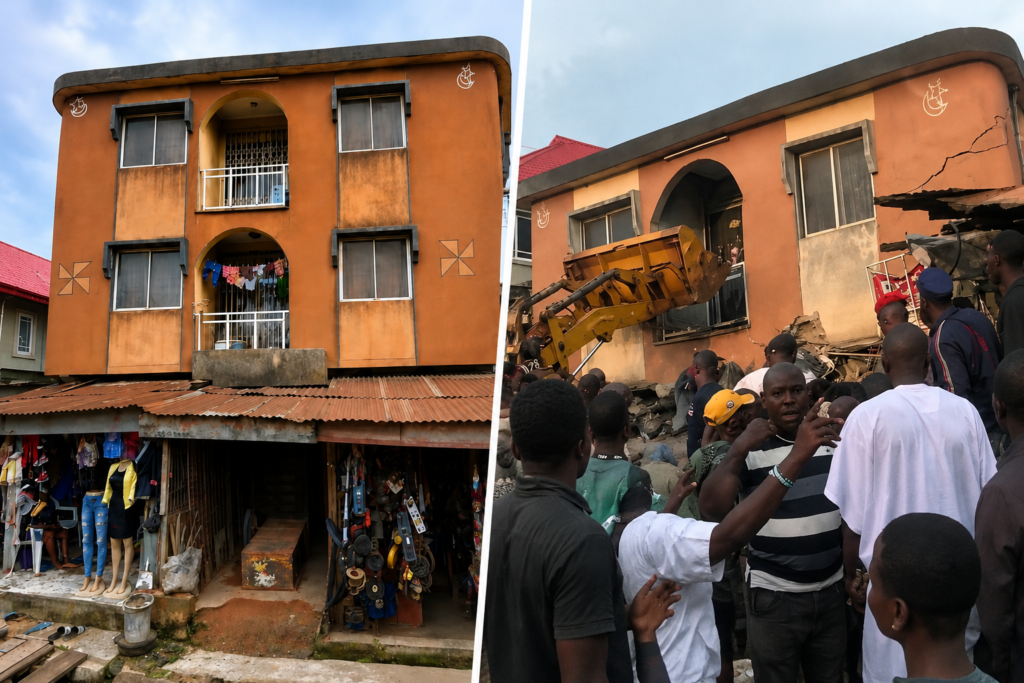
Ogun State Governor Dapo Abiodun has ordered a full investigation into Monday’s building collapse in Ajuwon, Ifo Local Government Area, that claimed three lives and left 12 others rescued from the rubble. As investigations continue, additional details emerging from the scene are providing more insight into how the tragedy unfolded.
The two-storey mixed-use building on Baale Road, near OGS Bus Stop, collapsed on the afternoon of July 27, shortly after a heavy downpour and thunderstorm swept through the area. Unlike most building collapses that topple sideways, this structure sank almost straight down as its foundation reportedly failed, leaving sections of the upper floor still visible above the wreckage. The unusual scene left many eyewitnesses shocked and confused about what they were seeing.
According to residents who spoke to reporters at the scene, the building was about 15 years old and belonged to a local man identified as Alhaji Moshood. Some tenants had reportedly moved out in the months leading up to the collapse after noticing cracks in the structure. However, there is no indication that the reported structural defects were brought to the attention of the relevant authorities before the incident.

What Happened, and Who Was Lost
The ground floor of the building housed commercial shops, while residential apartments occupied the upper floor.
Three people lost their lives in the collapse: an adult woman, a baby girl, and a 75-year-old man. Their bodies were recovered from the debris and taken to the Ifo Mortuary after search-and-recovery operations, which lasted for more than a day.
Twelve people survived the collapse, including two infants—each about 41 days old—from two different families. Their survival has been widely described as remarkable, considering the extent of the structural failure.
Rescue operations involved the Ogun State Emergency Management Agency (OGSEMA), Ogun State Fire and Safety Services, the Ministry of Works and Infrastructure, the National Emergency Management Agency (NEMA), the Nigeria Police Force, and—following a request for assistance—the Lagos State Emergency Management Agency (LASEMA). Emergency responders deployed excavators and payloaders to carefully remove debris while searching for anyone who might still have been trapped beneath the collapsed structure.
Setting the Record Straight
In the hours following the collapse, conflicting claims spread rapidly across social media. Some posts alleged a much higher death toll than official figures, while others claimed the collapsed building was a four-storey structure.
After reviewing information released by the relevant emergency agencies and the Ogun State Government, GTVDAILY.com confirmed that the building was a two-storey mixed-use structure, not a four-storey building as widely claimed online. Official reports also confirmed that three people lost their lives, while 12 others were rescued alive.
The confusion over the building’s height likely resulted from the unusual nature of the collapse. Because the structure sank almost vertically due to foundation failure instead of toppling outward, portions of the upper floor remained visible above the rubble. From certain angles and in widely shared videos, this created the false impression that a much taller building had collapsed.
While early online speculation generated conflicting casualty figures, the confirmed loss of three lives remains a heartbreaking tragedy for the affected families and the community.
An Investigation That Goes Beyond One Building
Governor Abiodun’s directive extends beyond determining the immediate cause of this particular collapse. He has also renewed warnings against the use of substandard construction materials, weak foundations, poor workmanship, and other unsafe building practices that continue to contribute to building failures across the country.
Construction experts have repeatedly identified ignored structural cracks, inadequate maintenance, poor regulatory compliance, and compromised building standards as some of the major factors behind many building collapses in Nigeria. Heavy rainfall, such as the downpour that preceded Monday’s incident, often acts as the triggering event rather than the root cause, exposing weaknesses that may have existed for years.
Residents living in or around older buildings are advised to take visible cracks, unusual settlement, or other signs of structural distress seriously. Such warning signs should be reported promptly to the appropriate authorities, while property owners should seek professional structural assessments rather than waiting for conditions to worsen.
As investigations continue, many Nigerians hope the findings will lead to stricter enforcement of building regulations and greater compliance with approved construction standards, helping to prevent similar tragedies in the future.