
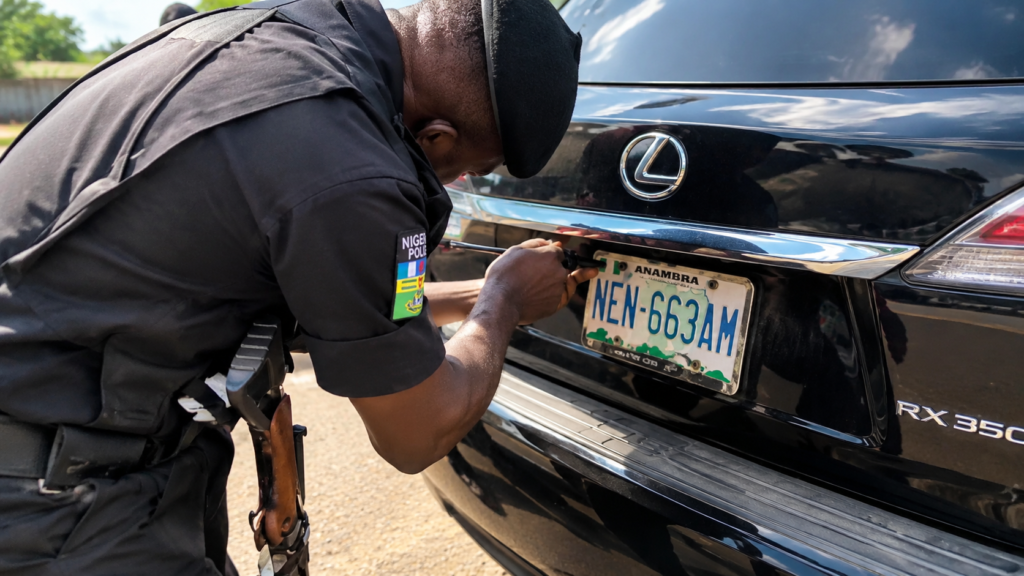
A 41-second video of a Nigerian police officer unscrewing the rear number plate off a black Lexus SUV has set off a familiar argument online: does the police even have the power to do that?
The clip, posted by @NigeriaStories on X, shows a man in police uniform and beret working a screwdriver into the plate — NEN-663AM, an Anambra State registration — while the driver keeps asking the same question over and over: why is my plate coming off, and what did I do wrong?
The officer never answers him on camera. He just keeps unscrewing.
What’s actually in the footage
The driver isn’t shy about pushing back. He tells the officer he’s being recorded. He warns him not to scratch the car. He insists, more than once, that he hasn’t committed any offence serious enough to justify this. And at one point he brings up something specific: he says he had a tinted-glass permit, but lost it, and that he’d already told the officer this before the plate came off anyway.
None of that changes what happens next. The officer keeps working.
That’s the whole story the video tells — and it’s an incomplete one. There’s nothing in the clip showing what happened before the camera started rolling, why the car was stopped in the first place, or what the officer believed the driver had actually done. Without that, it’s genuinely hard to say who’s in the right here.
Does the lost-permit detail matter?
It might. Context helps explain why.
In January 2026, the Nigeria Police Force suspended enforcement of its tinted-glass permit policy nationwide after a Delta State court issued an interim order blocking it — this came right as the Force was preparing to relaunch enforcement on January 2, 2026. Police said at the time they were complying with the court “strictly,” while fighting to get the order lifted. Months on, the legal back-and-forth between the police and the Nigerian Bar Association over the policy still hasn’t fully settled.
So when the driver in the video says he had a permit and lost it — rather than never having one — that’s not a small distinction. It’s the difference between a paperwork lapse and outright non-compliance. Still, the video doesn’t confirm this was even why he was stopped. It’s just one detail he raised, unanswered on camera.
The bigger enforcement push behind this
Number plates have become a genuine police priority this year. In June 2026, Inspector-General Olatunji Rilwan Disu ordered commissioners and tactical commanders nationwide to crack down on vehicles with no plates, or with plates that are altered, defaced, covered, or otherwise hard to read. Offending vehicles, the directive said, should be stopped, impounded, and taken through the appropriate legal process.
That’s real and it’s active — police units around the country have been running these operations for months.
But here’s the gap: that directive talks about stopping and impounding vehicles. It doesn’t say anything about an officer physically unscrewing a plate at the roadside. Those aren’t the same thing, and the difference is exactly what’s fueling the debate around this video. Having the authority to enforce plate regulations isn’t automatically the same as having a clear, specific authority to remove one yourself, on the spot, with a screwdriver.
So was it legal or not?
Honestly — we don’t know yet, and neither does anyone judging this from the video alone.
Vehicles are required to display valid plates, and police clearly have grounds to act against ones that don’t. But whether unscrewing a plate roadside, without an audible explanation to the driver, falls within that authority is a separate question the footage simply doesn’t answer. Calling it unlawful right now would be getting ahead of the facts. So would defending it as obviously fine.
What’s missing is the stuff that actually matters: what triggered the stop, what offence (if any) the officer suspected, and whether removing the plate was standard procedure or something this officer decided to do on his own.
Frequently Asked Questions
Can Nigerian police legally remove a car’s number plate during a stop?
Police have the authority to enforce vehicle registration laws, including stopping and impounding vehicles with missing, altered, or concealed plates. Whether an officer can physically unscrew and remove a plate roadside — as opposed to impounding the vehicle itself — isn’t spelled out in the enforcement directives reviewed for this piece. It’s a real grey area, not a settled rule.
Is the tinted-glass permit policy still in effect in Nigeria?
The policy itself hasn’t been scrapped, but enforcement has been tangled in court since a Delta State order paused it in January 2026. The Nigeria Police Force and the Nigerian Bar Association remain at odds over it, and the legal dispute was still unresolved as of mid-2026.
What should a driver do if an officer starts removing their plate without explanation?
There’s no official public guidance specific to this scenario, but the driver in this video did the sensible things: stayed calm, stated clearly that he was recording, and kept asking for the officer’s reason. Recording an interaction is generally accepted practice for accountability, though drivers should avoid escalating the situation physically.
Why are Nigerian police cracking down on number plates in 2026?
IGP Olatunji Rilwan Disu’s June 2026 directive links the enforcement push to broader security concerns — the Force says criminals increasingly use vehicles with hidden or altered plates to evade identification during robberies, kidnappings, and other crimes.
Where this leaves things
Plates exist for a reason — they help police trace vehicles tied to crime, and enforcement against tampered or missing ones isn’t unreasonable on its face. But drivers are also entitled to know why something is being done to their vehicle, especially something as disruptive as having a plate taken off in the middle of the road.
Until the police, the driver, or someone else with direct knowledge of the stop comes forward, this one stays open. What’s clear is that it’s touched a nerve — about how far police powers extend, and how much explanation a motorist is owed when an officer decides to act.